
Imagine you need to move Bitcoin to Monero before a meeting in Manhattan. You want the swap fast, private, and under your control — no KYC gate, no custodial delay. Wallet-integrated exchanges promise that convenience: swap inside the app, keep your keys, and leave fewer breadcrumbs. But that neat scenario conceals several technical trade-offs and limits that matter to privacy-minded U.S. users. This article walks through the mechanisms behind in‑wallet swaps, how they interact with Monero’s privacy model and Haven protocol assets, where privacy gains are real, and where hidden costs or failure modes can erode anonymity.
I’ll assume you know the basic difference between custodial exchanges and non‑custodial wallets. What matters here are the plumbing choices: how an in‑wallet exchange discovers rates, routes cross‑chain flows, and touches metadata (IP, node selection, view keys). Understanding those mechanisms gives you a practical mental model to choose tools and to reduce surprise when things go wrong.
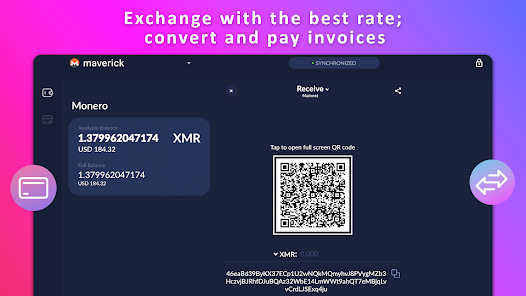
How an in‑wallet exchange actually works (mechanisms, not slogans)
There are two dominant patterns for swapping inside a wallet: (1) a centralized API that quotes and executes trades via an exchange service, and (2) decentralized, peer‑to‑peer routing that assembles a trade from liquidity providers. Wallets that prioritize non‑custodial control increasingly favor the latter because it avoids handing funds or keys to a third party. One practical implementation used by some wallets is automated routing via a system like NEAR Intents: the wallet broadcasts an intent to buy/sell and a set of market makers respond with quotes; a routing engine composes the optimal path and completes the swap without custodial custody.
Mechanically, a non‑custodial, NEAR‑style routing flow typically proceeds: the wallet prepares a transaction or series of transactions, the routing layer selects market makers and paths, and the wallet signs and submits transactions locally. For Monero, the wallet must create native XMR transactions and never expose the private spend key. For cross‑chain flows (e.g., BTC → XMR), the routing layer handles on‑chain settlement steps and may use intermediaries to bridge chains.
What privacy is actually protected — and what isn’t
There is a common misconception that “in‑wallet swap = perfect privacy.” That overstates the case. A correct, more useful synthesis is: in‑wallet swaps can reduce custodial risks and keep private keys local, but they do not automatically remove all metadata leakage. Which metadata remains depends on three design choices: network layer routing (Tor/I2P vs. clearnet), node selection for blockchain queries, and whether any view keys or transaction data leave the device.
When a wallet implements Tor‑only mode and I2P proxy support and allows custom node selection, it removes one large vector: IP address linkage to on‑chain activity. Cake Wallet’s support for Tor‑only mode, I2P, and user‑selected nodes means the wallet can, in principle, avoid exposing your IP to third‑party nodes during sync or swap negotiation. That matters in the U.S. context where network subpoenas and endpoint metadata can be more easily compelled than cryptography.
But other leakages persist. The swap routing layer — even if non‑custodial — often needs to query liquidity providers for quotes. Those queries could include amounts, ephemeral addresses, or timing information. If those queries are routed without anonymization, participants can correlate requests with subsequent on‑chain movements. So the wallet’s privacy posture depends both on local key handling (good: non‑custodial, private view keys kept on device) and on network anonymity (good if Tor/I2P or remote trusted nodes are used; weaker on clearnet).
Specifics for Monero, Haven protocol, and cross‑chain swaps
Monero’s privacy model gives structural advantages here. Subaddresses, ring signatures, and stealth outputs mean an on‑chain observer cannot easily link incoming and outgoing XMR transactions. A wallet that keeps the private view key offline and supports background sync with subaddresses preserves these properties well. That said, when you swap into or out of Monero, the linking risk shifts to the bridge between the chains: a correlated BTC spend and XMR receipt—especially if done through the same IP or quoted to the same market maker—can reveal relationships. The practical heuristic: maximize network-layer anonymity during the swap and use subaddresses for receipts to compartmentalize funds.
Haven protocol (XHV) and other privacy coins present similar but distinct profiles: many inherit privacy primitives but differ in how change outputs and staking-like features behave. For multi‑currency wallets, the operational requirement to support dozens of assets raises surface area; each asset’s protocol idiosyncrasies (e.g., Litecoin MWEB activation, Zcash mandatory shielding) need careful handling. A useful rule: treat each asset’s privacy as separate — a leak on one chain does not automatically break Monero’s privacy, but routing correlations can still link them.
Trade-offs you’ll face
Three key trade‑offs recur in practice:
1) Convenience vs. Network Anonymity: Instant swaps via built‑in routing are convenient and avoid export/import hassles. But convenience often depends on querying multiple liquidity providers. If the wallet uses Tor/I2P and custom nodes, that mitigates risk; if not, you trade convenience for greater exposure of query metadata.
2) Liquidity and Rate Quality vs. Privacy Surface Area: NEAR‑style decentralized routing seeks competitive rates by contacting multiple market makers. That tends to improve price and reduce slippage, but it broadens the set of entities that see swap intents. If you prefer minimal party exposure, you may sacrifice the best rate for fewer counterparties or use a longer time window to split swaps.
3) Native asset privacy vs. Cross‑chain Correlation: Monero retains strong on‑chain privacy, but swapping engages off‑chain participants and inter‑chain bridges. The stronger the bridge’s decentralization (non‑custodial, many market makers), the lower the counterparty risk—but not zero. Expect residual correlation paths unless you combine network anonymity, delay tactics, and address compartmentalization.
Implementations and limits worth knowing
Some concrete limits are not immediately obvious. For example, Zcash migration from certain wallets can be blocked by differences in how change addresses are handled; you may need to transfer ZEC manually into a newly created wallet. That operational friction matters if you are consolidating assets before a swap. Also, hardware integrations (Ledger, air‑gapped Cupcake) enhance private key security, but they don’t automatically anonymize the network layer; pair them with Tor/I2P and custom node use for best effect.
For more information, visit monero wallet.
Another practical boundary: zero data collection and open‑source code are strong governance signals, but they are not full guarantees. Open‑source means someone can audit the code; zero telemetry reduces developer-side logging. Still, users must verify builds, update timely, and maintain device security — device‑level encryption like Secure Enclave or TPM and local PIN/biometric gates are necessary but not sufficient safeguards against endpoint compromise.
Decision‑useful heuristics for U.S. privacy practitioners
Here are compact heuristics to apply when choosing or using an in‑wallet exchange for Monero and other privacy coins:
– If you prioritize minimizing custody risk, prefer non‑custodial, open‑source wallets that keep private keys local and support hardware wallets.
– If you prioritize minimization of network metadata (IP address) during swaps, insist on Tor/I2P and custom node options. Do not assume that non‑custodial = anonymous on the network layer.
– When moving into Monero from a transparent chain, use subaddresses and delay between legs if possible; avoid immediate, single‑leg large swaps that create strong timing correlations.
– For cross‑chain privacy where rates matter, accept that contacting multiple market makers improves price but expands exposure. If you need fewer counterparties, consider splitting a swap or accepting a worse rate.
For practical comparison, a privacy‑focused wallet that supports these features—open source, Tor/I2P, custom nodes, NEAR‑style decentralized routing, hardware wallet integration, and no telemetry—delivers a strong balance of control and convenience for U.S. users. If you want to explore one such option for Monero specifically, see this monero wallet.
What to watch next (signals, not predictions)
Watch three developments that would materially change the balance of privacy vs. convenience: wider adoption of stronger decentralized swap protocols that leak less query metadata; integration of built‑in, privacy‑preserving relays for quote aggregation; and UX improvements that make using Tor/I2P and hardware wallets frictionless for mainstream users. Conversely, regulatory pressure that pushes more market makers to require identity for liquidity provision would raise the privacy cost of decentralized routing. These are conditional scenarios — keep an eye on whether liquidity providers start publishing KYC policies tied to API access and whether wallets add obfuscation layers for swap queries.
FAQ
Does swapping inside a Monero‑capable wallet reveal my private keys?
No. In a properly implemented non‑custodial wallet, private keys (including the private view key) never leave your device. The swap process signs transactions locally. The remaining privacy concerns are metadata (IP addresses, quote requests) and cross‑chain correlation, not direct key exposure.
Will using Tor or I2P make in‑wallet swaps completely anonymous?
Tor or I2P greatly reduces network‑level linkage by hiding your IP, but they do not eliminate all correlation routes. Timing correlations, shared counterparties, and explicit data sent during quote requests can still link actions across chains. Use network anonymity alongside address compartmentalization and careful timing to reduce overall linkage risk.
Are in‑wallet swaps always safer than using an external exchange?
“Safer” depends on which risk you prioritize. In‑wallet swaps avoid custodial custody and protect keys, which is a major safety gain. However, if your wallet routes swaps through many counterparties without network anonymization, you may increase metadata exposure. Evaluate custody risk vs. metadata risk for your threat model.
What should U.S. users do differently compared with other regions?
U.S. users should assume network metadata can be subject to legal process and monitor counterparties’ KYC/AML policies. Favor wallets that support Tor/I2P, custom nodes, and decentralized routing with many liquidity providers; combine that with hardware key protection and up‑to‑date software to reduce both legal and technical exposure.